
Final Fantasy VII Revelation is massive, impressive, and makes me a little nervous - hands-on
Final Fantasy VII Revelation is absolutely enormous. Its size is such that it clearly inspired Square Enix to give a demo quite unlike any of I’ve had from the company, save for an early taste of Final Fantasy XV’s open world: an offering of complete freedom from a company usually a fan of more skittish, highly directed teasers.
A demo like this has its pros and cons. An hour to do whatever you like sounds delightful on paper - in practice, it can be easy for the time to be sapped away muddling around at the fringes and for you to experience little of the game as a result. Here, though, that’s almost the point. We all know how these games play. FF7 Revelation is built on the same foundation, and we don’t all need to go over that again. The point here is to drive home that mind-bending scale.
At the start of this hands-on, which takes place at the onset of FF7 Revelation’s Chapter 4 (more on this in a moment, lore fans), players are simply set loose. The offering is in a sense akin to that moment where you first step out of the sewers in Oblivion, or first leave the cave in Breath of the Wild. Almost the whole wide world is there, and it is absolutely your oyster - and in this instance, you traverse the whole world in a few minutes thanks to your trusty airship.
For Final Fantasy VII aficionados, let's just quickly jump into what this actually means in the context of the narrative of the original game. At the onset of Chapter 4, Cloud and Tifa are gone from the party. NPC chatter talks about a Weapon attack on the town of Mideel, so I assume that the developers have folded that into the existing events there. For what it’s worth, I’m pretty sure they haven’t moved Icicle Inn’s placement in the story, as my understanding is that Snowboarding is unlocked at the Gold Saucer at this point. This is minutiae, but we love a bit of granularity here on RPG Site.
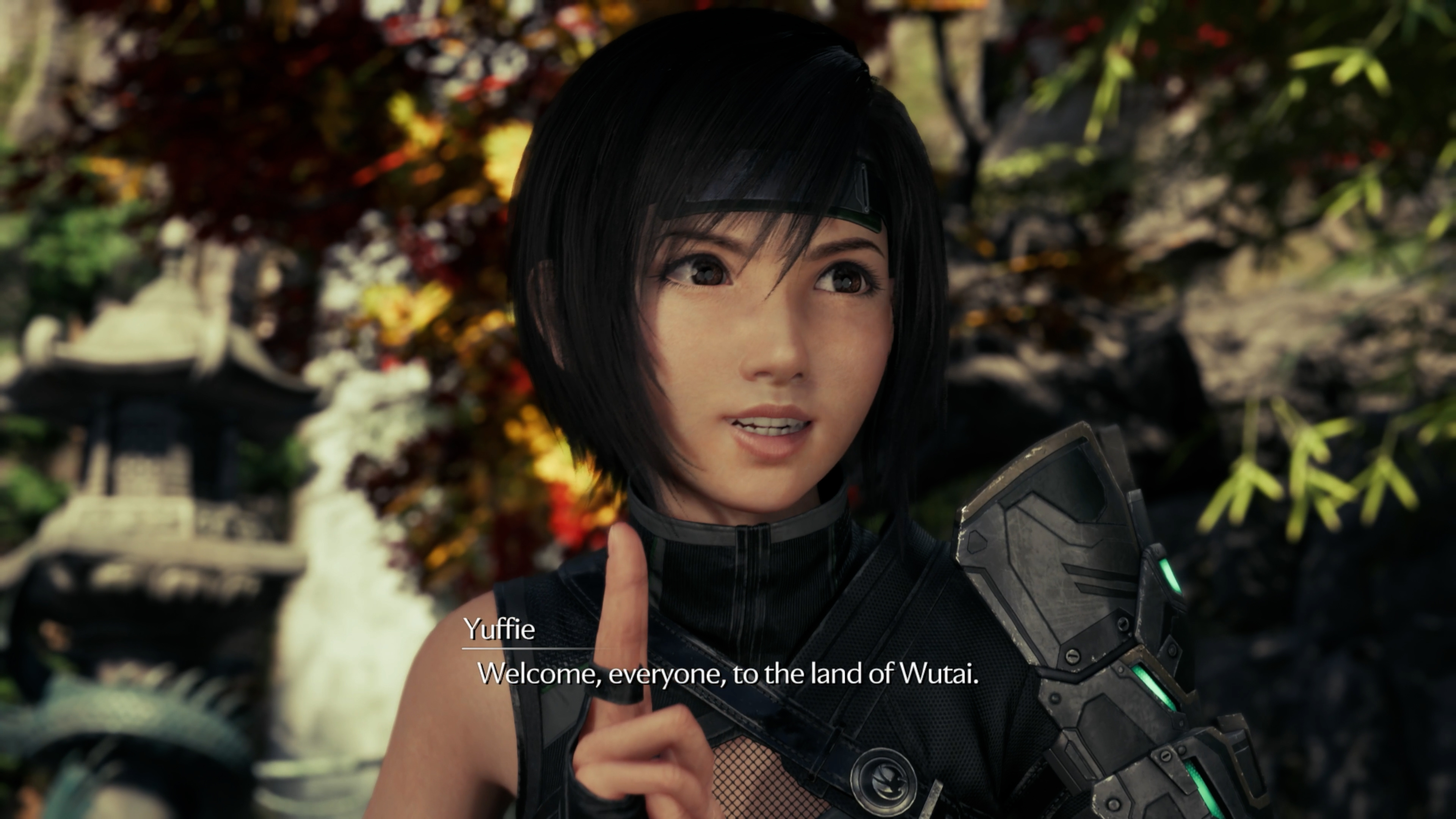
The chapter kicks off with a nice story scene up top that essentially sets Yuffie up as the de facto leader of the party, which is a pretty nice idea given the broader context. Here, you’re given your marching orders: if you head to Wutai, access to the Highwind will be temporarily revoked and the main story of Revelation will progress. You don’t have to do that straight away, however - you can explore the world to your hearts’ content.
You can fly the Highwind to any of the Rebirth areas, plus Mideel. Revelation’s developers have done an admirable job of stitching together the world map as we saw it in Rebirth. These zones aren’t any bigger than they were, carefully woven together with chunks of inaccessible mountain range and the like. In the end, the way the world ebbs and flows from one zone to the next absolutely feels natural.
Mideel appears equivalent to perhaps the smallest zone of Rebirth - while from the air, at least, Wutai looks huge. You're kept out of the other zones with excuses, even though you can fly the Highwind anywhere. Midgar's got a no-fly zone, the Ice Glacier has poor visibility, Rocket Town has Shinra forces, etc. This all works fine enough; it’s totally acceptable video game stuff.
he world map is ultimately genuinely impressive. I don’t think we’ve seen this sort of overworld travel done in a 3D game to this quality and extent ever before. The world feels enormous, even though the areas themselves aren't any larger than they were. It's quite a feat that has been accomplished, and it boggles my mind a little to think about how they've done so, especially in the notoriously open world unfriendly Unreal Engine. People have cooked here.
Part of that accomplishment is obviously in the execution, and that can come with little compromises. When you’re flying the Highwind, the camera angle sits pretty tight - something that I don’t think feels the best, especially when you’re trying to line up a specifically-targeted parachute drop-in. But I get why: it evokes the camera angle of the original game, but more importantly, doing so makes the world feel bigger, as you can see less of it at any given time.
Those parachute jumps are truly impressive once you’re out of the Highwind, however. You have good control over the parachute, and anything that was accessible in Rebirth, for instance, can be landed on. The game does subtly nudge you away from anything silly, like inaccessible mountain ranges. I tried to see if I could parachute onto the Gold Saucer, onto one of its helipads - but no, you can’t do that. You have to land in the desert and take the elevator up.
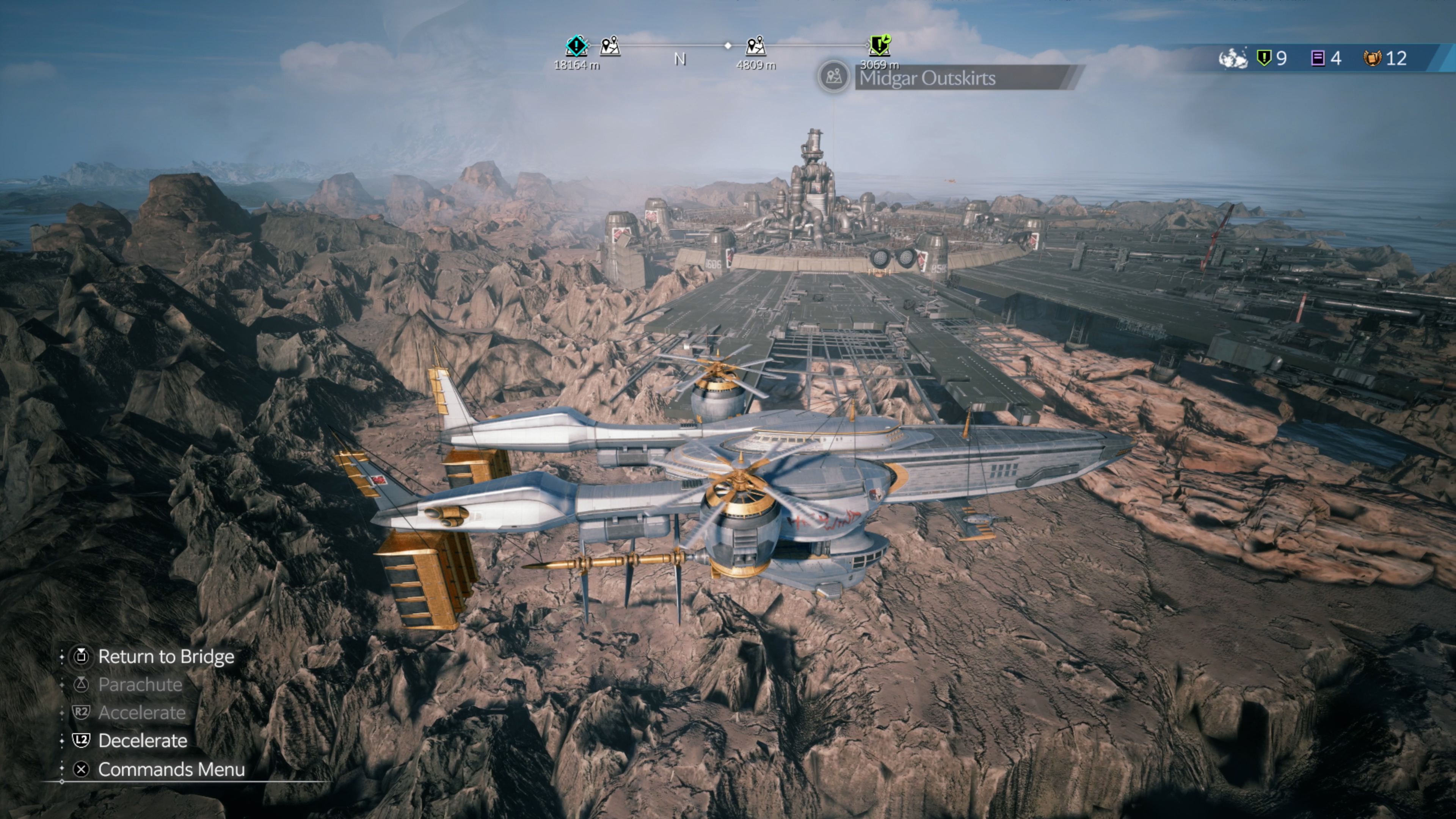
You can see from the sky that Midgar is the same sort of deal. There's definitely no assets down there that are hiding a proper load-in of the city when you parachute in. When they do that, it will surely be a cutscene. If these things are the cost for such a massive open world, though, I’ll take it.
If you parachute down into one of the Final Fantasy VII Rebirth areas, as soon as your feet touch the ground, there's a familiar ping as you open up Chadley's device, and he and Mai give you a whole bunch of new objectives. Some of these seem familiar to Rebirth - for instance I pretty much instantly heard the coo of one of those birds that leads to a summon shrine - but there are, of course, new things also. In the Corel Desert, for instance, there’s the beginnings of the Ruby Weapon questline.
It's clear that this sort of stuff is the bedrock of Final Fantasy VII Revelation, at least beyond the concluding arc of FF7’s main story. It’s clear that you’re not entirely equipped to tackle Ruby Weapon at this point, but if you want to head straight to Corel Desert and attempt it in Chapter 4, you’re welcome to. The hands-on gave me the sense that the quest is really meant to sit there until later in the game - but those with a death wish can parachute down and attempt to take on the beast’s tentacles to make the full-size Weapon spawn. Even defeating those tentacles is a tall order, though - and doing so is probably best saved for later.
The freedom is there though, and Ruby Weapon is just one thing to do in this chapter. As I said, every area you land in sees Chadley buzz you and inject a slew of map icons and quest log items. There’s a lot to do. I was told that you could get ten or fifteen hours of content here before heading to Wutai to progress the story.
There's much to love about this, though it does prickle a vein of concern, as well. Broadly, when you look at this hands-on, you see a game that has had the absolute kitchen sink thrown at it: a huge open world, all areas from Rebirth complete with new side content, a job system, the promise of a return to Midgar… on one hand this is absolutely brilliant. On the other, one can’t help but wonder if there’s a chance of it all feeling too much.
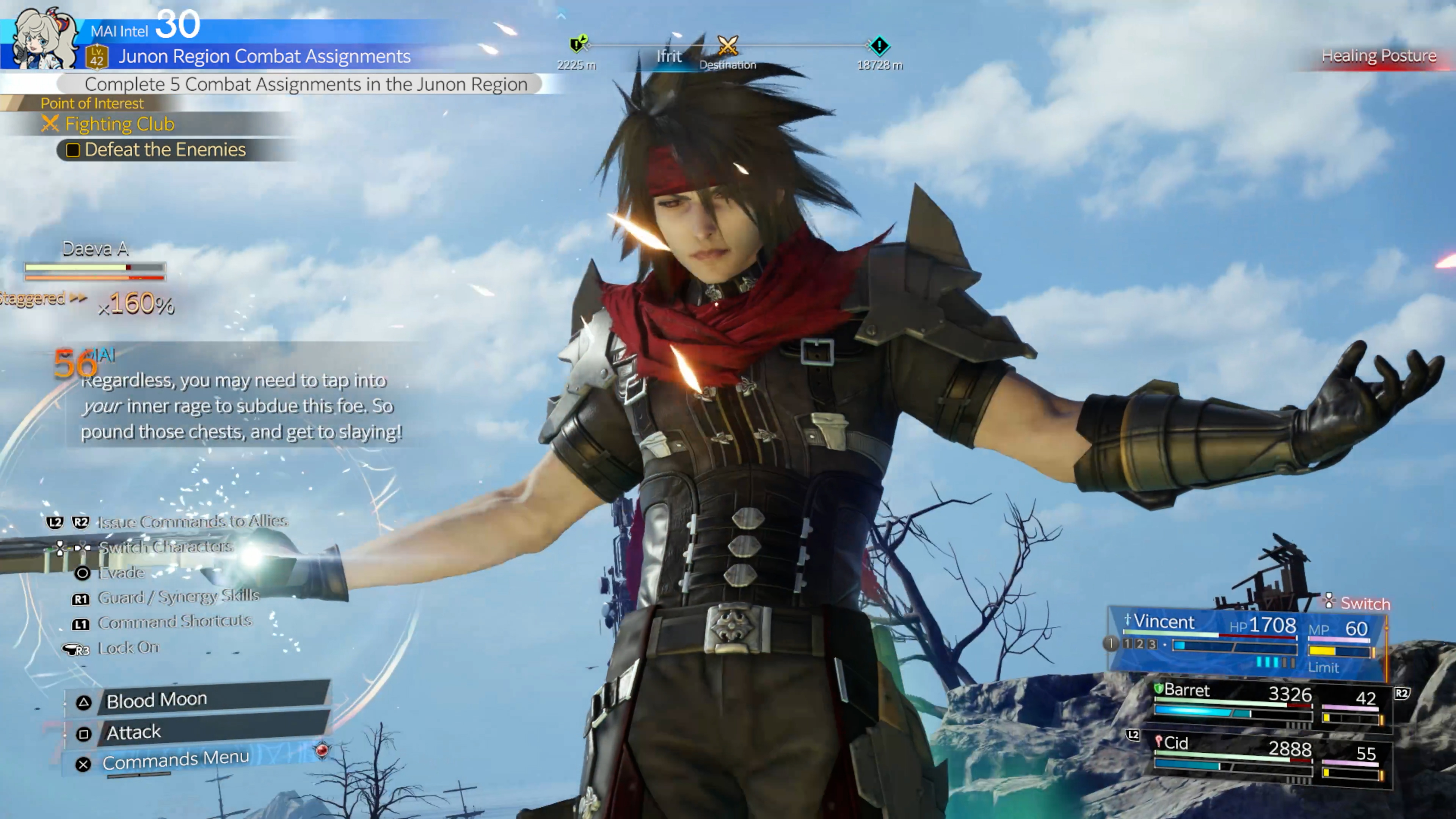
I confess even in this hands-on to feeling that touch of classic open world anxiety as I saw the sheer amount of stuff that gets injected into your UI each time you arrive in a new area. That isn’t helped, of course, by half the areas being familiar zones we’ve already explored. Yeah, you can mainline the story but for an optimum experience, there’s a balance to be found in busywork, and I hope they find it. That is the needle that Naoki Hamaguchi and his team must thread, and a one-hour hands-on is not nearly enough time to see if they have or will be successful.
The rest is sort of business as usual. The characters are as charismatic as they have ever been. The battle system remains thrilling. Vincent and Cid appear to be canny additions to the battle system's repertoire, though I don't think anybody should be terribly surprised when I say they play well, stand out uniquely, and seem a fitting version of those characters. This combat has always been great and continues to do so - the newcomers appear great and smart additions.
In a way, the Final Fantasy VII Remake project has taken on a new meaning. It’s not just a remake of Square’s most famous title; it also now represents what the developers at Square Enix are capable of when they don't have to start over fresh each time. Rebirth built upon the steadfast foundations of Remake and the end result was the most critically acclaimed Final Fantasy game in decades. Revelation aims to continue that trajectory by simply adding more: more content, more features, more areas, more everything. Yes, it's the highly anticipated finale of the story, but that was not the focus of this hands-on. The focus was an open world with scale and size that we haven't really seen in a game of this stripe before.
It's pretty mind-bogglingly impressive. There's that tiny voice in the back of my head that reminds me that sometimes less is more, and that this is something that many video games misunderstand. On the flip side, I think back to the original Final Fantasy VII and I'm reminded that it also had a kitchen sink approach, where no matter how zany the enemy idea, the minigame pitch, or the story twist, it all made it in. That was a game where, by Hironobu Sakaguchi's own admission, the team left practically nothing on the table. And so it feels appropriate for the third and final part of the Final Fantasy VII trilogy to follow the same idea. I just hope that the balance is right. If it is, this could be a truly special experience.
Final Fantasy VII Revelation launches on April 8th, 2027. It's a busy day for FF7 previews here - so now you're done here, check out our impressions on battling Ruby Weapon, our interview with the game's team, and our sister site's interview with director Naoki Hamaguchi.